
In this article:
Overview
Streamline succession planning by assigning Plan Owners to manage individual plans. Succession Plan Assignments allows users with Succession Permissions to delegate responsibility to those with insight into their team’s needs, reducing administrative workload while maintaining oversight.
Because Plan Owners can access sensitive employee data, assign ownership based on the responsibilities of their role and their need to manage a specific plan. Before granting access, set clear expectations for confidentiality and appropriate use.
This article walks through the basics of getting started with Succession Plan Assignments.
About Succession Plan Assignments
This optional feature allows Users with Succession Permissions to designate Plan Owners to oversee individual plans —empowering the right individuals to actively participate in the succession planning process.
Plan Owners
By default, Users with Succession Permissions own all succession plans. They can choose to give an additional user—called a Plan Owner—access to manage a specific plan. Even with delegated ownership, Succession Planning Users with full access still maintain visibility and oversight.
Plan Owners can view, add roles, nominate candidates, import candidates or update data, and use presentation mode—but only within their assigned plan.
Important to note, Plan Owners can also view all data available within their assigned plan, including Talent Review data, private goals, and engagement data they may not otherwise have permission to access.
Assign ownership only to individuals who need this information to manage the plan. Before granting access, make sure they understand the scope of their access and their responsibility to use employee data appropriately and maintain confidentiality.
You can assign multiple owners to a single plan—and individual users can manage multiple succession plans. Owners assigned to multiple succession plans can easily toggle between options but will not have visibility into the global overview page available.
Default Plan
All existing roles within Succession Planning are automatically placed into a plan by default.
To assign plans to individual owners, simply create a new plan, assign roles into it, and designate Plan Owners to manage them.
Creating a New Succession Plan
Learn how to create and name a new succession plan.
Assigning Roles to a Succession Plan
Follow step-by-step instructions to move roles into your newly created plan.
Designating Plan Owners
Learn how to assign ownership of plans to the appropriate team members.
Assign Plan Owners who need to manage the plan as part of their role and can be trusted to handle confidential employee information appropriately.
Before You Assign a Plan Owner
Plan ownership grants access to sensitive employee data within the assigned plan.
As best practice before assigning an owner, we recommend to:
- Confirm a business need: Choose someone whose responsibilities require them to manage this specific plan.
- Review the available data: Consider the Talent Review ratings, private goals, and engagement data the owner will be able to view.
- Set clear expectations: Explain how the information should be used and the owner’s responsibility to maintain confidentiality.
After assigning ownership, periodically review who has access, especially when an owner’s role or responsibilities change.
FAQs
Q: Can I create a plan without assigning a Plan Owner?
A: Yes! Plans can be created without any assigned Plan Owners. In these cases, Succession Plan Users automatically retain ownership. This is a helpful way to group and stage roles before officially assigning ownership.
Q: What are my options for implementing Succession Plan Assignments?
A:
-
No Change
Continue managing and rolling out succession plans as you do today—no immediate changes required. -
Create Groups & Assign Ownership
Succession Plan Users create empty groups of succession plans, assign ownership of those groups, and allow Plan Owners to identify and manage relevant roles. -
Create Groups, Add Roles, & Assign Ownership
Succession Plan Users create a plan, add roles to it, and then assign a Plan Owner. The Plan Owner will then take over managing the assigned roles within that plan.
Q: How should I group new succession plans?
A: Plans can be grouped in a way that makes sense for your organization. Common groupings include:
-
By Department (e.g., “Finance” or “Engineering”)
-
By Location (e.g., “Omaha Branch” or “EMEA Region”)
Q: Who can see all succession plans?
A: Users with Full Administrator access and a Succession User role in their profile (aka Succession Admins) can see all plans.
Q: What if I have Succession Planning access but am not a Full Admin?
A: You’ll be a Plan Owner and can only see the plans you own.
Q: What if I don’t have Succession Planning access but am added as a Plan Owner?
A: You will automatically be granted Succession Planning access for those plans.
Q: What data can a Plan Owner see within their assigned plan?
A: Plan Owners can view all data available within their assigned plan, including Talent Review data, private goals, and engagement data for employees included in the plan. This may include information they cannot access outside Succession Planning.
This access allows owners to effectively manage their assigned plans. Grant ownership only when needed for someone’s role, and establish expectations for confidentiality and appropriate use before assigning access.
Q: How do Focused Admins’ permissions work with Succession Planning?
A: Focused Admins with Succession Planning access only see the plans they own, similar to Plan Owners.
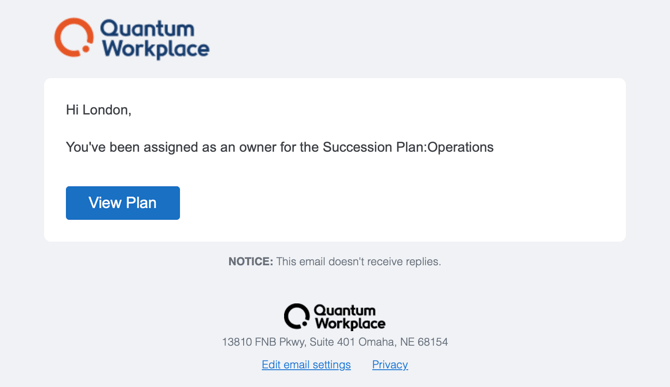
Q: Are Plan Owners notified when they are assigned to Succession Plans?
A: Yes, new Plan Owners receive email notifications, as displayed below.
One HR platform for connected talent insights. See how Quantum Workplace brings your data together across 1-on-1s, talent reviews, performance reviews, and more—so you can spot trends, act fast, and make more informed people decisions. Explore the interactive product tour or request a personalized demo with your Customer Success Manager.